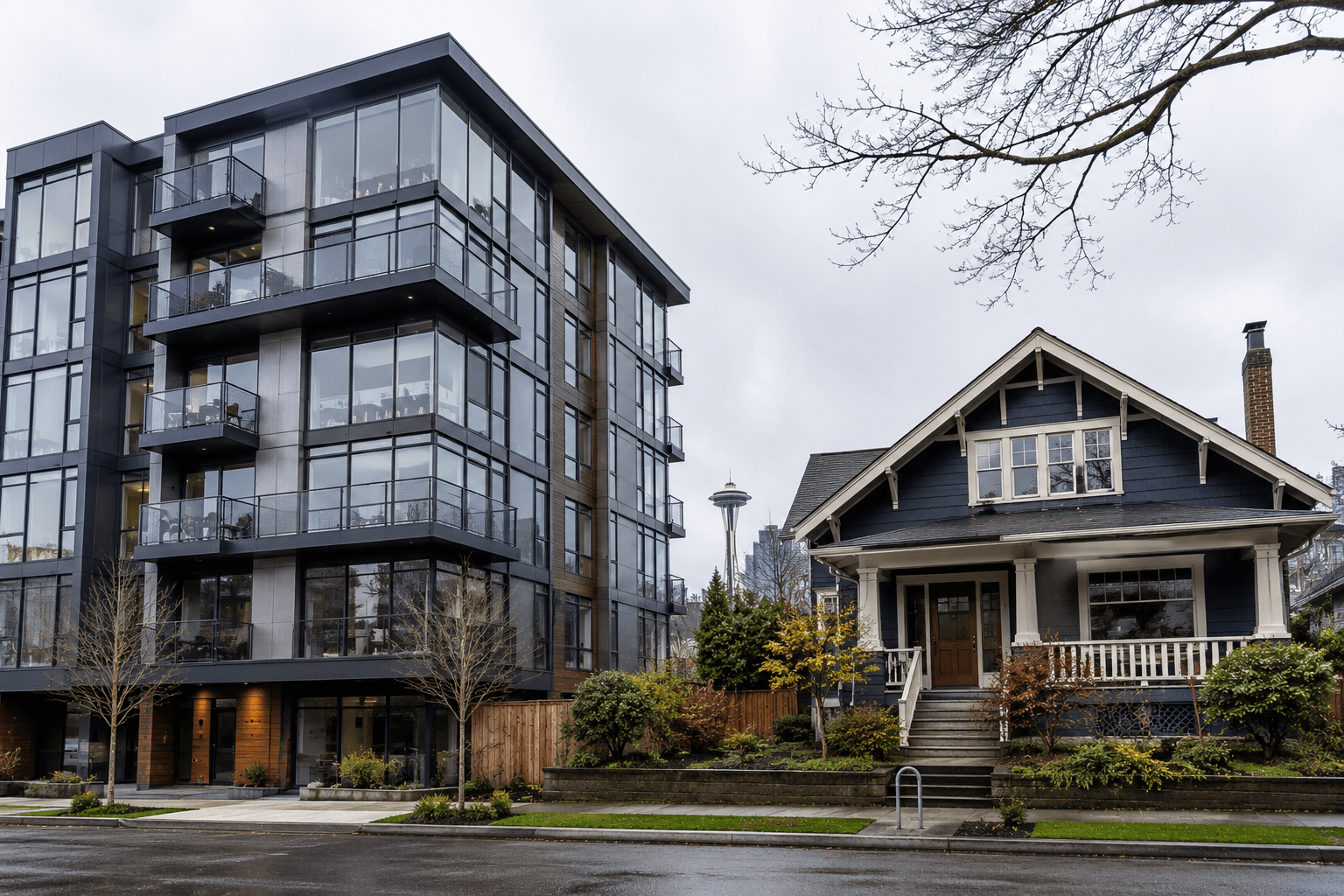
The Core Trade-Off: Control vs. Convenience
Owning a condo means you own your unit but share the building, common areas, and infrastructure with other owners. The homeowners association (HOA) manages shared expenses, maintenance, and building rules. You gain convenience — no exterior maintenance, no landscaping, often no parking management — but you cede some control over costs and decisions to the HOA.
Owning a single-family home means full ownership of the structure and the land beneath it. You are responsible for all maintenance and improvements, but you make all decisions about how the property is managed, modified, and used. That autonomy comes with real costs — both financial and in time.
Price Comparison in Seattle's 2026 Market
Entry-level condos in Seattle range from the mid-$300,000s for studio and one-bedroom units in neighborhoods like Capitol Hill, South Lake Union, and First Hill, to $600,000 to $1.2 million for larger, view-oriented units in premium buildings. The price per square foot is often higher than single-family homes in comparable neighborhoods — but the total purchase price is lower.
Entry-level single-family homes in Seattle's desirable neighborhoods begin around $750,000 for smaller, older homes needing work, and quickly climb past $1 million for renovated three-bedroom homes in areas like Ballard, Wallingford, or Greenwood. Land value is a component that condos cannot offer at any price.
Understanding HOA Fees and Special Assessments
HOA fees in Seattle condo buildings range widely — from $300 per month for smaller buildings with minimal amenities to over $1,500 per month for high-rise buildings with concierge, gym, and rooftop facilities. These fees must be factored into your total monthly housing cost when comparing affordability to a single-family home.
Special assessments — one-time charges levied by the HOA for major repairs not covered by reserves — are a significant risk. Buildings with underfunded reserves are more likely to impose assessments. Before purchasing a condo, review the HOA's reserve study, meeting minutes, and financial statements carefully. A single large assessment can represent tens of thousands of dollars in unexpected cost.
Appreciation: Which Performs Better Over Time?
In the Seattle metro, single-family homes have historically appreciated faster than condos over long time horizons. Land appreciates; buildings depreciate. A single-family home on a desirable lot in an established neighborhood captures both dimensions — and land supply is structurally limited in Seattle's geographically constrained market.
Condos can appreciate meaningfully in strong markets and in well-managed buildings, but they are more vulnerable to oversupply (new construction adds condo inventory in ways that rarely happen with single-family) and to building-specific issues that can suppress value. The condo market in Seattle experienced a soft period in 2023–2024 before recovering in 2025 — a cycle that the single-family market largely avoided.
Lifestyle Fit: The Questions That Matter Most
Do you want outdoor space — a yard, a garden, a private patio? Single-family. Do you want to minimize maintenance and travel frequently without worrying about a home to manage? Condo. Do you want to be in the urban core near restaurants, transit, and nightlife within walking distance? Condo. Do you want quiet, space, and privacy? Single-family.
For buyers in their first home, a condo often makes financial sense as an entry point — lower purchase price, lower maintenance costs, and urban proximity that fits an early-career lifestyle. For families or buyers planning to stay in place for ten or more years, single-family homes in established neighborhoods tend to offer better long-term financial performance and lifestyle fit.
Financing Differences You Should Know
Condos are subject to additional lender scrutiny that single-family homes are not. Lenders evaluate the financial health of the HOA, the percentage of units that are owner-occupied vs. rented, and whether the building is involved in any pending litigation. Buildings that fail these tests may not qualify for conventional financing, which limits the buyer pool significantly at resale.
VA and FHA loans have additional condo approval requirements. Buyers planning to use these financing products should verify that any condo they are considering is on the approved list before making an offer.
Frequently Asked Questions
Can I rent out a condo I purchase in Seattle? Most condo HOAs permit rentals, but some have restrictions on the number of units that can be rented at any time or require owner-occupancy for a minimum period before renting. Review the CCRs (Covenants, Conditions, and Restrictions) before purchasing if rental flexibility is important to you.
Is condo insurance different from homeowner's insurance? Yes. Condo owners purchase an HO-6 policy, which covers the interior of the unit and personal property. The HOA's master policy covers the building structure and common areas. Understanding where one policy ends and the other begins is important — and gaps in coverage are common.
Do condos have property taxes? Yes. Condo owners pay property taxes on their unit, assessed independently by the King County Assessor. HOA fees are separate from property taxes and not tax-deductible.
The condo vs. house decision is ultimately a lifestyle question dressed in financial clothing. Clarify what you value most in your daily life — and the right answer usually becomes obvious.